EBITDA Leakage: The Hidden Threat Most Companies Ignore
Press Release | 9 June 2026
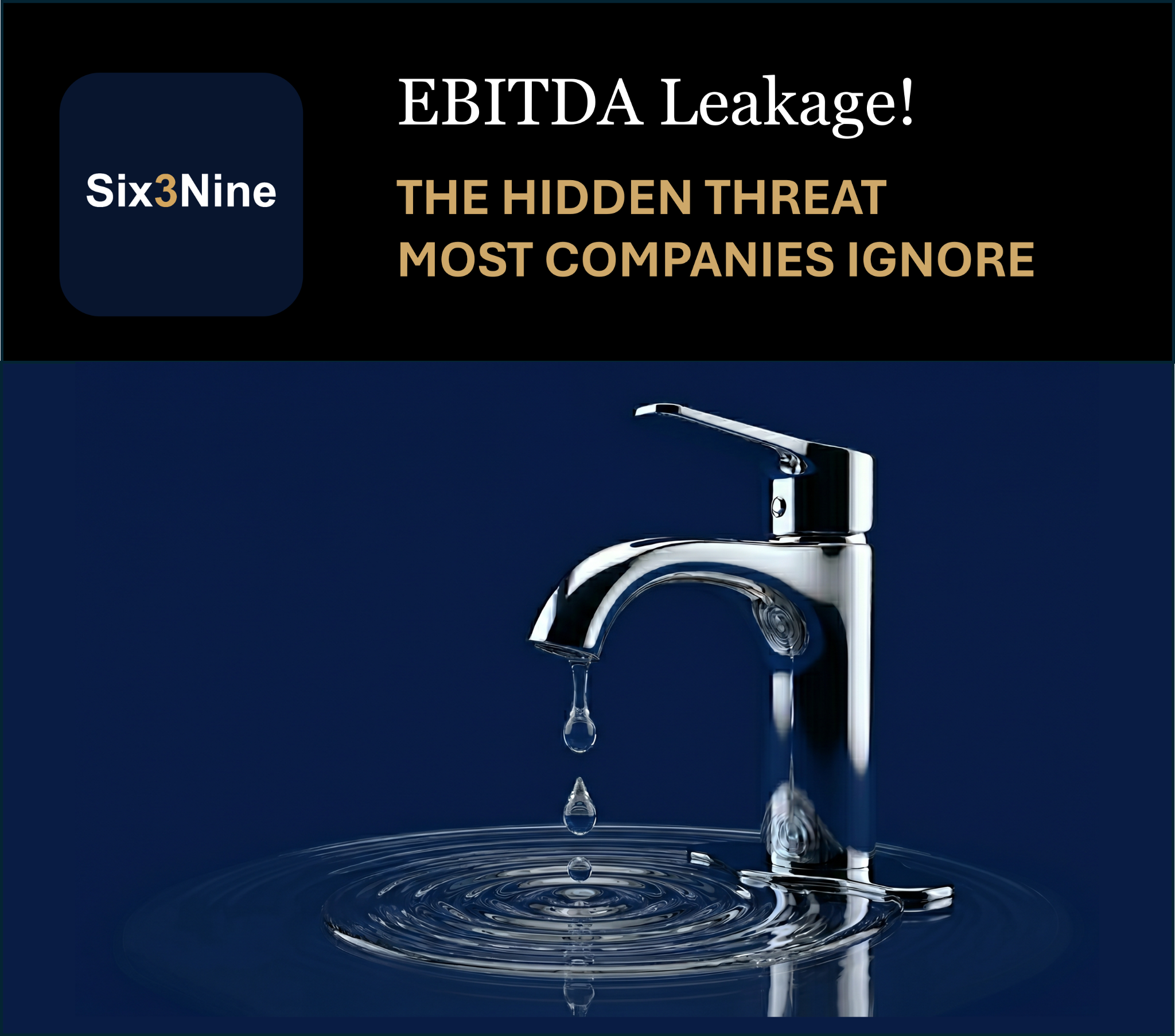
Most companies focus intensely on growing revenue; sales targets dominate board meetings, growth strategies drive executive decisions, and market expansion consumes investment and leadership attention.
Yet while organizations work tirelessly to increase revenue and margins- their core business objective, many are simultaneously losing millions in profitability through an invisible and largely unmanaged problem: EBITDA leakage.
Unlike a major operational failure or a sudden financial shock, EBITDA leakage happens quietly. It rarely appears dramatically on financial statements or triggers immediate panic. Instead, it slowly erodes profitability, weakens margins, reduces enterprise value, and undermines shareholder returns—often without leadership fully realizing the scale of the damage.
In many organizations, the single greatest source of this erosion sits within procurement and third-party spend management.
What Is EBITDA Leakage?
EBITDA leakage refers to the gradual loss of operating profit caused by inefficiencies, uncontrolled spending, weak governance, poor supplier management, and missed commercial opportunities. It is the difference between the EBITDA a company should be generating and the EBITDA it actually delivers.
This leakage is rarely caused by one catastrophic event. Instead, it accumulates through hundreds of overlooked problems:
- Weak Category Management: Lack of category-specific procurement strategies leads to weak negotiation practices, supplier proliferation, unmanaged discounts or supplier-driven price increases.
- Operational Friction: Maverick spending (off-contract purchasing or purchasing outside preferred vendors), poor inventory and demand management, and, most critically, insufficient stakeholder alignment and engagement.
- Contractual Decay: fragmented procurement processes result in uncontrolled renewals, contract leakage, invoice discrepancies and missing rebates due to insufficient contract lifecycle management.
- Governance Gaps: Limited spend visibility, inadequate performance monitoring, weak compliance controls, and ineffective transformation governance.
Individually, these may appear insignificant. Collectively, they can destroy millions in EBITDA annually.
The Strategic Multiplier: Why €1 of Leakage is Worth €10 of Growth
To understand the true scale of the threat, executives must look through the lens of Sales Equivalency.
For a company operating at a 10% net profit margin, every €100,000 lost to EBITDA leakage requires €1,000,000 in new revenue just to offset the loss. In a tightening market, it is significantly more certain to capture a euro of existing waste than to generate ten euros of new, profitable sales.
Furthermore, the impact on Enterprise Value is profound. In an era where mid-market companies are often valued at an 8x to 12x EBITDA multiple, capturing €1M in leakage doesn’t just improve the year-end balance sheet—it potentially adds €10M to the company’s valuation upon exit or refinancing.The Hidden Math of Leakage
- The Savings: €500K in bottom-line optimization (e.g., managing "Tail Spend").
- The Sales Equivalent: €5M in new top-line revenue required to match that impact (at a 10% net margin).
- The Enterprise Value Impact: €5M in potential valuation lost or won (at a 10x EBITDA multiple).
Why Procurement Sits at the Center of the Problem
In most organizations, procurement influences between 50% and 80% of total enterprise spend. Yet, it is still too often viewed as a transactional back-office function rather than a strategic control point for EBITDA protection.
Wherever large-scale spend exists, EBITDA leakage exists. Without strong procurement governance, organizations lose control over supplier pricing, contract compliance, and vendor rationalisation. The result is margin erosion that compounds year after year.
EBITDA Leakage During Transformation and M&A
The risk accelerates during periods of transformation and Mergers & Acquisitions (M&A). These environments create complexity and disruption—ideal conditions for Synergy Erosion.
In many acquisitions, EBITDA leakage begins immediately after deal completion. The "Value Gap"—the distance between projected synergies and realised EBITDA—widens because companies pay different prices to the same vendor across different business units or allow legacy contracts to auto-renew during the chaos of integration. Without procurement leadership, the synergies promised to the board often fail to materialise.
Why Traditional Cost Cutting Often Fails?
When profitability pressures increase, many companies respond with "blunt force" measures: hiring freezes, budget slashes, or workforce restructuring. While these deliver short-term relief, they fail to address the structural causes of leakage.
True EBITDA protection is not about temporary reductions; it is about Procurement Governance. This requires:
- People – the key success factor
Without a lean and well-governed procurement organization, led by accountable and capable professionals, EBITDA leakage is inevitable.
- Full Spend Visibility
Knowing exactly who is spending what, with whom, under which contractual commitments, and identifying the preferred vendors across each category is critical to ensuring control and delivering results from day one post-merger.
- Contractual Discipline
Ensuring 100% compliance with negotiated terms. A clear contractual framework and governance policy are essential to minimize EBITDA leakage and secure expected synergies.
- Continuous Optimization
Moving to data-driven, cross-functional operating model with clear accountability and continuous performance improvement.
Final Thought: A Mindset Shift
The companies that outperform in the next decade will not necessarily be those with the fastest revenue growth. They will be the companies that manage margin with discipline and protect EBITDA aggressively.
Procurement must no longer be viewed as administrative overhead. It must be recognised as a strategic financial control engine and a protector of enterprise value.
Most companies know how much revenue they generate. Far fewer understand how much EBITDA they lose silently every year. Identifying and eliminating that hidden erosion is no longer optional—it is essential to competitiveness.
Contributors
Ingrid Rowe
Senior Partner | Six3Nine
London, UK
Santiago Bello
Senior Partner | Six3Nine
Valencia, Spain
About Six3Nine
Six3Nine is an independent boutique procurement consultancy specialising in turning procurement into EBITDA impact. We combine deep expertise in procurement operations, digital transformation, AI applications and complex business change to deliver sustainable business value.
Technology-agnostic and independent of solution providers, we focus on what best fits each client's needs. Our strength lies in understanding how procurement works, identifying where value can be unlocked and delivering the right blend of transformation, technological innovation and commercial optimisation to achieve measurable results.