The Future Human and Agentic Procurement Operating Model
Press Release | 7 July 2026
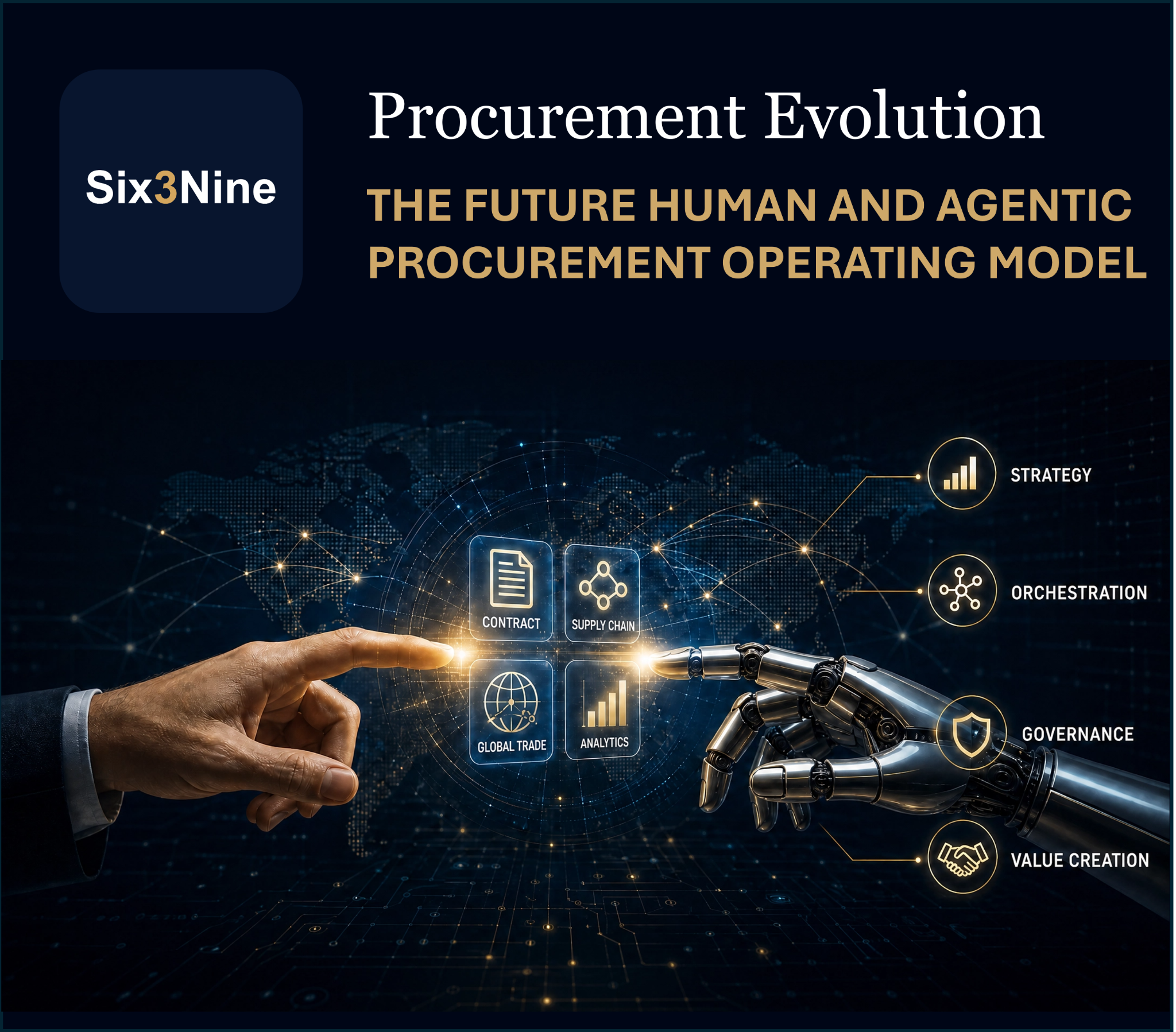
There is a question that every Chief Procurement Officer should ask before entering their next operating model redesign: not "what processes can we automate?" but "who, or what system has the authority to execute this decision?" The answer reveals whether an organisation is preparing for the future or merely accelerating the past.
Over the past decade, corporate procurement operated primarily as a tactical cost-control function. Its core value proposition was anchored in efficiency, compliance, and spend visibility. Digital transformations layered automation onto legacy enterprise resource planning (ERP) systems, but the underlying operating model remained human-centric and process-heavy.
Today, an unprecedented convergence of generative AI and autonomous systems is driving a structural shift in how procurement operates inside the enterprise. The transition from digital assistants to agentic AI systems that can independently perceive, decide, and execute tasks, is forcing a fundamental redesign of the procurement operating model.
Leading organisations are not replacing human capital; rather, they are augmenting procurement teams with cognitive capabilities that reduce administrative friction and unlock strategic leverage. The future of procurement is not a human-only or machine-only construct. It is a highly orchestrated Human and Agentic Organisation Model.
The Agentic Shift: From Tools to Actors
To understand the future operating model, we must first distinguish between traditional automation and agentic AI. Traditional automation follows predefined, static sequences. Digital assistants require human prompts to trigger actions.
Agentic systems are fundamentally different. They are goal-driven actors. They dynamically regulate their own assigned processes, operate across tools and systems, validate results against rules, and escalate when activity falls outside established guardrails. They maintain context across multi-round negotiations and initiate actions based on inferred needs, not just explicit instructions.
This distinction is critical. When software transitions from a tool to an actor, it requires a new governance framework. The central challenge for CPOs is no longer technology deployment; it is organisational design.
According to the IBM Institute for Business Value, 78% of C-suite executives agree that achieving maximum benefit from agentic AI requires a new operating model. By 2027, 67% of executives expect AI agents to take independent action in their organisation — up from 24% today.
The Four Pillars of the Human-Agentic Operating Model
The future procurement operating model does not make the traditional functional blocks — Category Management, Source-to-Contract, Procure-to-Pay, and Supplier Management — obsolete. Instead, it fundamentally changes how humans and machines interact within those blocks.
We identify four structural pillars that define the Human-Agentic Organisation Model:
1. Work Runs in Bounded Lanes
In the agentic model, work is segmented by complexity and risk. Standard, repeatable tasks such as tail spend negotiations, purchase order matching, basic compliance checks, supplier onboarding are run end-to-end within autonomous lanes governed by explicit guardrails. Humans concentrate on exceptions, complex strategic trade-offs, and high-value relationship management.
Exceptions become the primary unit of management. Performance is increasingly measured by exception volume, time to process exceptions, and whether recurring exceptions decline over time. This is not a reduction in procurement's importance; it is a sharpening of its focus.
2. Policy Becomes Executable
Historically, procurement policies, preferred pathways, rate cards, clause positions, and evidence requirements were guidelines enforced by human review. In the agentic model, policy becomes executable code. Agents automatically enforce compliance, shifting the organisation from retrospective auditing to real-time, proactive governance.
This structural change has profound implications for risk management. Organisations that deploy agentic AI effectively can increase their annual return on investment up to five times and boost procurement productivity by 60% or more, enabling incremental savings of 3% to 7% (Bain & Company, April 2026).
3. The Orchestration Layer
The future architecture relies on an orchestration layer that coordinates specialised, multi-agent systems. Instead of monolithic ERP platforms dictating workflow, an ecosystem of specialised agents collaborates. A contract review agent flags liability risks while a spend analytics agent simultaneously verifies budget availability. A supplier risk agent monitors geopolitical signals while a forecasting agent adjusts demand projections in real time.
The orchestrator ensures these agents act in concert, drawing from a unified enterprise data core. This is not simply automation; it is procurement as a continuous intelligence ecosystem.
4. Cognitive Specialisation and Human Oversight
Agentic AI requires explicit delegation of decision rights. Strategic trade-offs, complex supplier negotiations, and ethical judgments remain human-led. Procurement professionals transition from process administrators to system governors defining goals, setting controls, interpreting complex results, and managing the supplier relationships that machines cannot replicate.
The table below illustrates how decision authority is distributed across the Human-Agentic model:
Editorial review: original decision-authority table not supplied.
The Governance Imperative
The transition to a Human and Agentic Organisation Model is not a technology upgrade; it is an institutional shift. When autonomous agents operate at machine speed, failures resemble organisational breakdowns rather than simple software bugs. Accountability becomes ambiguous. Governance frameworks designed for deterministic software are inadequate.
The Agentic Operating Model requires four interdependent governance layers:
- Cognitive Layer: Deploying specialised, domain-specific agents rather than broad, general-purpose models. Smaller, focused models are easier to audit, constrain, and align with delegated responsibilities.
- Coordination Layer: Governing how agents interact with one another to accomplish complex tasks, transitioning from centralised orchestration toward decentralised collaboration.
- Control Layer: Real-time monitoring, escalation protocols, and audit-grade logging that ensure agents operate within defined boundaries.
- Governance Layer: Clear RACI frameworks defining which decisions AI can execute autonomously, which require human-in-the-loop checkpoints, and which remain strictly manual.
Without this governance architecture, organisations risk scaling dysfunction rather than value.
What Can Procurement Do Now?
The transition to a Human and Agentic Organisation Model requires deliberate, sequenced action. CPOs should focus on three immediate priorities:
First, establish data as infrastructure, not reporting. Without harmonised supplier, spend, and contract data, agentic AI amplifies noise rather than intelligence. A strong enterprise data core is the foundational prerequisite for autonomous execution. Fragmented ERP environments and inconsistent master data are the most common barriers to agentic deployment.
Second, redesign decision rights explicitly. The central question is no longer "what should be automated" but "who, or what system has authority over which class of decisions." Organisations must define a clear RACI matrix for AI agents, determining which decisions can be executed autonomously, which require human oversight, and which remain strictly manual. According to Forrester's Q1 2026 survey, 53% of CPOs are now setting AI decision rights as a critical enabler of speed at scale.
Third, invest in capability transformation, not tool adoption. The future procurement organisation is defined less by the systems installed and more by the team's ability to interpret, challenge, and govern AI-generated intelligence. Procurement talent must evolve to include data fluency, system orchestration, and advanced relationship management skills. The organisations winning in the autonomous AI future are those building cross-functional teams that combine procurement expertise, data science, and product ownership.
The Strategic Imperative
The organisations that excel in the coming decade will share a common characteristic: they have redesigned their procurement function around autonomous decision-making capabilities, preserving human agency where it is most crucial.
Suppliers are already deploying AI agents of their own. Companies that delay may find themselves consistently out-negotiated. Their cost structures will be inflated, their supply chains less resilient, and digital talent will gravitate toward organisations working at the frontier. AI advantages compound. Early movers are building stronger systems, better data, and deeper institutional capability.
This is not primarily a technology capability. It is a procurement and governance capability: the ability to understand the structural logic of agentic systems, to identify where real autonomy creates leverage, and to govern that autonomy safely at scale.
The combination determines whether your procurement function remains a tactical cost centre or evolves into a continuous intelligence layer that shapes enterprise cost, risk, resilience, and growth in real time.
Whether you design the model — or whether the model designs you!
References
[1] Bain & Company. The Rise of Autonomous, Intelligent Procurement. April 2026. https://www.bain.com/insights/the-rise-of-autonomous-intelligent-procurement/
[2] Oliver Wyman. How to use agentic AI to boost procurement efficiency. March 2026. https://www.oliverwyman.com/our-expertise/insights/2026/mar/agentic-ai-transform-procurement-operating-model.html
[3] IBM Institute for Business Value. Agentic AI's Strategic Ascent: Shifting Operations from Automation to Autonomy. October 2025. https://www.ibm.com/thought-leadership/institute-business-value/en-us/report/agentic-ai-operating-model
[4] California Management Review. Governing the Agentic Enterprise: A New Operating Model for Autonomous AI at Scale. March 2026. https://cmr.berkeley.edu/2026/03/governing-the-agentic-enterprise-a-new-operating-model-for-autonomous-ai-at-scale/
[5] Zycus / Forrester. Why Procurement Is Too Slow in 2026. May 2026. https://www.zycus.com/blog/agentic-ai/forrester-why-procurement-too-slow-cpo-fix
[6] The Hackett Group. Agentic AI and Procurement (Part 1): What Is Agentic AI? June 2025. https://www.thehackettgroup.com/insights/agentic-ai-and-procurement-part-1-what-is-agentic-ai/
[7] Deloitte. Multi-Agentic AI for sourcing & procurement. 2026. https://www.deloitte.com/us/en/services/consulting/blogs/business-operations-room/multi-agent-ai-sourcing-procurement.html
______________________
Procurement Evolution, a Six3nine series, delivers continuous, hard-hitting insights on AI and procurement.
👉 [Follow us on LinkedIn] to ensure you never miss an update and maintain your competitive edge.
Contributors
Ingrid Rowe
Senior Partner | Six3Nine
London, UK
Santiago Bello
Senior Partner | Six3Nine
Valencia, Spain
About Six3Nine
Six3Nine is an independent boutique procurement consultancy specialising in turning procurement into EBITDA impact. We combine deep expertise in procurement operations, digital transformation, AI applications and complex business change to deliver sustainable business value.
Technology-agnostic and independent of solution providers, we focus on what best fits each client's needs. Our strength lies in understanding how procurement works, identifying where value can be unlocked and delivering the right blend of transformation, technological innovation and commercial optimisation to achieve measurable results.